⚠️ The GLP-1 Whistleblower Warning: What Pharmacy and Medicine Must Confront Now

A viral video is raising uncomfortable questions…
A recent “whistleblower-style” video circulating online has ignited serious discussion across healthcare:
👉 Are GLP-1 weight-loss drugs being promoted too aggressively — without full consideration of long-term consequences?
The tone is provocative.
The claims are confronting.
But beneath the emotion lies something far more important:
⚠️ A growing body of real-world concern that the profession can no longer ignore
🎥 What the Video Gets Right (And Why It Matters)
The video highlights several key issues that are not speculation — they are documented realities:
1. Legal scrutiny is escalating
- Thousands of lawsuits are now consolidated in U.S. multidistrict litigation
- Claims include:
- Gastroparesis (stomach paralysis)
- Bowel obstruction
- Vision complications
The number of cases continues to rise — now exceeding 3,000+ active claims in federal proceedings
👉 This alone signals a shift:
From hype → to accountability
2. Mechanism comes with trade-offs
GLP-1 drugs work by:
- Suppressing appetite
- Slowing gastric emptying
But this same mechanism is also:
- Linked to gastrointestinal side effects
- Being studied in relation to gastroparesis-like conditions
👉 In simple terms:
The very mechanism that drives weight loss may also contribute to unintended complications.
3. Real-world patient experience is evolving
Beyond clinical trials, large-scale analysis of patient reports shows:
- 43% of users report at least one side effect
- Most common:
- Nausea
- Fatigue
- Vomiting
- Constipation
👉 This matters because:
Clinical trials ≠ real-world behavior, adherence, or outcomes
⚖️ What the Video Misses (And Why Balance Matters)
To be clear:
👉 The video is not a clinical paper
👉 It amplifies extreme cases
👉 It implies certainty that does not yet exist
Regulators and experts still emphasize:
- Many side effects are rare
- Benefits can be significant for certain populations
- More long-term data is still needed
Even recent research suggests genetic variation influences both effectiveness and side effects
🧠 The Bigger Issue No One Is Addressing
The real concern is not whether GLP-1 drugs “work.”
They do — in many cases.
The real issue is this:
❗ They are being positioned as a primary solution… without a system for sustainability
🚨 The Silent Risk: Dependency Without Education
Across pharmacy and clinical settings, a pattern is emerging:
- Patients lose weight rapidly
- Appetite is chemically suppressed
- No structured lifestyle education is provided
Then:
👉 The medication stops
👉 Hunger returns
👉 Weight regain begins
❗ This Is the Gap
GLP-1 therapy:
- Does not teach nutrition
- Does not rebuild metabolic flexibility
- Does not preserve muscle mass without intervention
- Does not prepare the patient for life after the drug
🏥 A Direct Message to Pharmacy and Medical Professionals
This is where the wake-up call becomes unavoidable:
✋️ If we prescribe without a pathway, we are not solving obesity — we are delaying it
The profession must ask:
- Where is the patient education?
- Where is the structured nutrition plan?
- Where is the exit strategy?
- Where is the long-term accountability?
🔄 The Shift That Must Happen
GLP-1 medications should not be:
❌ The solution
❌ The strategy
❌ The endpoint
They should be:
✅ A temporary tool
✅ A clinical entry point
✅ Part of a structured metabolic program
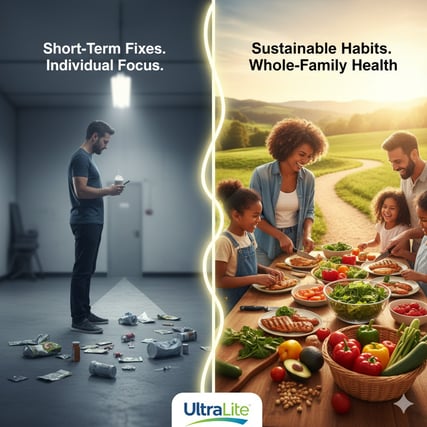
🌱 Introducing the Missing Layer: UltraLite
This is where the conversation must evolve.
Programs like UltraLite are not alternatives to medicine —
they are what medicine is currently missing.
They provide:
- Structured, whole-food nutrition
- Muscle-preserving protocols
- Patient education and empowerment
- A defined off-ramp from medication dependency
- A system that continues after the drug stops
🔥 The Real Opportunity for Pharmacy
This moment is not a threat.
It is a turning point.
Pharmacy can either:
👉 Remain a dispensing model
OR
👉 Step into a leadership role in metabolic health
📣 Final Word
The whistleblower video may be dramatic.
But the underlying message is real:
⚠️ We are scaling a pharmaceutical solution faster than we are building a sustainable one.
GLP-1 drugs are not the enemy.
But positioning them as the answer — without structure, education, and an exit strategy — is a mistake the profession cannot afford to ignore.