
A Critical Review with Practical Implications for Sustainable Health
Based on: Weight Loss That Lasts: Reviewing the Long-Term Impact of GLP-1 Receptor Agonists
Authors: Md Yasir Shah et al., PMC12361690 (2025)
The Obesity Challenge
Obesity remains one of the most pressing global health issues of our time, affecting over one billion people worldwide. It is now recognized as a chronic, relapsing condition that drives a multitude of metabolic and cardiovascular complications, including type 2 diabetes, hypertension, and heart disease. Despite widespread awareness, traditional diet and exercise programs have too often delivered only short-term success—with most individuals regaining weight within one to two years after initial loss.
In response, the medical community has increasingly turned to pharmacological solutions, and among these, GLP-1 receptor agonists (GLP-1 RAs) have captured global attention for their potent weight-reducing effects.
GLP-1 Agonists: A New Era of Medical Weight Management
This systematic review synthesizes high-quality randomized controlled trials (RCTs) published between 2018 and 2025, focusing on long-term outcomes with agents such as semaglutide, liraglutide, tirzepatide, and exenatide.
Across diverse populations—including individuals with and without type 2 diabetes—these medications demonstrated:
- Sustained weight loss over treatment durations of 40 to 120 weeks
- Improved glycemic control and cardiometabolic parameters
- Acceptable safety profiles, with mild-to-moderate gastrointestinal side effects being the most common
In clinical settings, these agents help suppress appetite, delay gastric emptying, and promote satiety—allowing users to significantly reduce caloric intake without feeling deprived. Such mechanisms explain why patients often experience rapid and substantial weight reduction, exceeding results achieved through lifestyle changes alone.
The Caveat: What Happens When Treatment Stops?
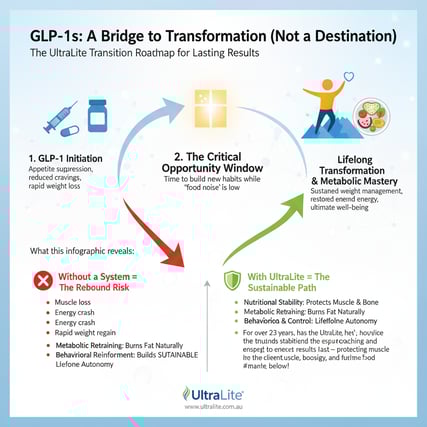
While the findings of Shah et al. reinforce the effectiveness of GLP-1 therapies, they also highlight an emerging concern: weight regain after discontinuation. Several long-term studies report that up to two-thirds of lost weight can return within a year of stopping medication, largely due to metabolic and behavioral adaptations.
This underscores a key truth:
Obesity is not just a medical condition—it’s a behavioral and lifestyle condition requiring lifelong support.
Pharmacological tools can help initiate weight loss, but they do not automatically transform long-term habits, nutritional awareness, or emotional relationships with food. Without these foundational changes, individuals remain dependent on ongoing medication to maintain results—a costly and often psychologically draining proposition.
The UltraLite Perspective: Where Science Meets Sustainable Living
For more than 26 years, the UltraLite Program has helped thousands of Australians achieve lasting weight loss and metabolic health through a proven, structured approach that integrates:
- Personalized nutrition based on real food
- Education around hormonal and metabolic balance
- Supportive coaching and accountability
- A focus on maintaining muscle mass while burning fat
The recent surge of GLP-1 therapies presents a unique opportunity—not to replace lifestyle programs, but to complement them. When individuals begin pharmacotherapy, UltraLite provides the behavioral and nutritional scaffolding that allows them to transition off medication without weight regain.
Just as importantly, UltraLite’s principles reinforce metabolic resilience—stabilizing insulin sensitivity, supporting gut health, and establishing sustainable eating habits that maintain weight naturally once medical therapy ends.
Integrating UltraLite with GLP-1 Therapy: A Holistic Model for Long-Term Success
The most effective long-term model emerging from this review is combination therapy:
- GLP-1 receptor agonists initiate weight loss and metabolic reset.
- UltraLite’s structured, educational, and supportive framework sustains those results for life.
This integrated approach bridges the gap between short-term pharmacological success and long-term behavioral transformation—enabling individuals to achieve what has long eluded conventional dieting: weight loss that truly lasts.
Conclusion: Beyond the Injection—Building a Healthier Future
The evidence is clear: GLP-1 receptor agonists such as semaglutide and tirzepatide represent remarkable medical advances in obesity management. Yet, as the review by Shah et al. reminds us, they are not a cure—they are a tool.
For genuine, enduring transformation, we must address the root causes of weight gain: poor dietary habits, metabolic inflexibility, and the emotional dimensions of food. This is where programs like UltraLite provide the missing link—guiding individuals toward independence from medication and restoring confidence in their ability to live healthfully, naturally, and sustainably.
References
Adapted from:
Shah MY, Mohammad A, Samejo RB, et al. Weight Loss That Lasts: Reviewing the Long-Term Impact of GLP-1 Receptor Agonists. PMC12361690 (2025).
For more information on sustainable lifestyle support, visit UltraLite.com.au.