2026 DGA ( the Dietary Guidelines for Americans) aligns with UltraLite Clean Keto.
Why the 2025–2030 Guidelines Mark a Historic Reset—and How UltraLite Has Been
Aligned With This “New Science” All Along.
For 40 years, official dietary advice told us the same story:
- Fear fat, especially saturated fat
- Choose “low-fat” and “fat-free.”
- Swap butter for seed oils
- Count calories and avoid red meat
Meanwhile, obesity, diabetes, fatty liver, and metabolic disease have exploded.
Now, with the release of the 2025–2030 Dietary Guidelines for Americans (DGA),
Something extraordinary has happened:
The very system that promoted low-fat, high-carb, highly processed food patterns is quietly
admitting it hasn’t worked—and is trying to hit the reset button.
UltraLite has been living in that “reset space” for over two decades.
This blog is your plain-English guide to what changed, why it’s controversial, and how it
vindicates the UltraLite clean keto, real-food, practitioner-guided approach.
1. What Are the Dietary Guidelines—and Why Do They Matter?
Since 1980, the DGA has been the master rulebook for U.S. nutrition policy.
It dictates what counts as a “healthy” meal in:
- School lunch programs
- Aged-care and hospital menus
- Military and government catering
- Nutrition advice from many official bodies
In other words, it shapes the food environment for at least 1 in 4 Americans – and influences
thinking globally.
By law, these guidelines must be based on the “preponderance of scientific evidence.”
For decades, that has been interpreted as:
“Lower saturated fat, replace it with vegetable oils, eat plenty of grains, and choose low-fat
everything.”
Sound familiar?
2. How the System Is Supposed to Work—Until This Year
Every five years, the U.S. government:
1. Appoints an independent expert committee (scientists, doctors, nutrition
researchers).
2. That committee reviews the evidence and writes a scientific report.
3. The government then turns that report into the final Dietary Guidelines.
Historically, what the experts recommended and what the government published were almost
identical.
But not this time.
3. What Changed in the 2025–2030 Guidelines?
The current administration called the new edition
“The most significant reset of federal nutrition policy in our nation’s history.”
Here’s what’s different:
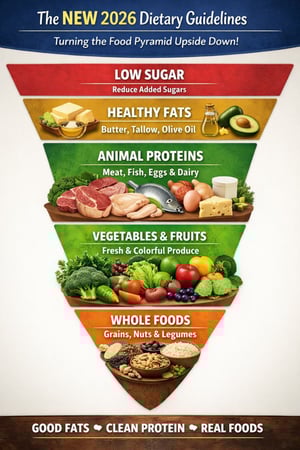
✅ From “low-fat” to “real food.”
The old focus was on nutrient numbers:
- % of calories from fat
- grams of saturated fat
- milligrams of sodium
The new focus is on food quality: - Minimally processed foods
- Whole, traditional foods (meat, eggs, full-fat dairy, vegetables)
- Avoiding ultra-processed foods built from refined starches, industrial seed oils, and additives
In other words: “Eat Real Food.”
✅ Whole-fat dairy is back in the picture
For the first time in decades, the new guidelines:
- Remove the insistence on “fat-free or low-fat” dairy
- Recognise whole-fat dairy as compatible with a healthy diet
- Keep the formal saturated fat limit at <10% of calories, but shift the concern largely to
- processed foods, not natural dairy and meat
This is exactly what UltraLite has practiced: real foods, whole fats, properly structured
within a clean keto framework.
✅ Higher protein is encouraged
The new guidelines “end the war on protein,” promoting higher protein intakes:
- Around 1.2–1.6 g per kg of body weight—far above traditional minimums.
- Emphasis on animal protein for its amino acid density and nutrient richness.
Again, this mirrors UltraLite’s long-standing focus on ample, high-quality protein to protect muscle, support metabolism, and stabilise appetite.
✅ Refined carbs and ultra-processed foods are finally called out
The new guidelines:
- Describe many refined grains as “sugar in disguise.”
- Urge a sharp reduction in processed carbohydrates
- Strongly discourage added sugars—especially in children—with a tone closer to
“avoid” than “moderation”
UltraLite has been sounding this alarm since 1999.
4. Why Is There So Much Controversy?
You’d think everyone would celebrate “eat real food, ditch the junk, respect protein.”
So why the explosion of anger and confusion?
Because the controversy isn’t just about what the guidelines say.
It’s about how they were made and what counts as “science.”
A clash of two scientific models
1. The traditional public-health model
- Relies heavily on large observational studies
- Looks at patterns across big populations
- Focuses on lowering LDL cholesterol as a key target
2. The new medical/clinical model
- Demands causal evidence from randomized controlled trials (RCTs)
- Says: “If you can’t prove a food causes harm in an RCT, you shouldn’t restrict
It's for everyone.”
The new administration rejected the expert committee’s report and built its own “scientific foundation” that heavily prioritises RCT data—including older, reanalyzed trials that question the simple “saturated fat → LDL → death” story.
Critics argue this move was procedurally wrong and politically motivated.
Supporters say it finally aligns official policy with what the stronger trials actually show.
Either way, the trust in the process has been shaken.
5. The One Thing Almost Everyone Agrees On
Despite the noise, there is powerful common ground:
Highly processed foods
Refined carbs and added sugars
Industrialised edible “products” built from flour, oils, and emulsifiers
…are driving metabolic disease.
Whether people shout “Make America Healthy Again” or “Uncompromised Science,” both
sides acknowledge:
When people move back to real, minimally processed foods, their health improves.
That is exactly where UltraLite lives.
6. How UltraLite Fits Into This “New Era”
For 26 years, UltraLite has:
- Prioritised whole, real, family-friendly foods
- Used a clean ketogenic, moderate-protein, low-sugar framework
- Avoided the “low-fat, high-grain” dogma
- Recognised that metabolic repair, not calorie counting, is the key to long-term change
- Delivered results in real people, under real practitioner supervision
The 2025–2030 Guidelines are, in many ways, the system catching up to what practitioner-led programs like UltraLite have already proven in practice.
They indirectly validate several of UltraLite’s core principles:
- Healthy fats from real foods are not the enemy
- Higher protein isn’t dangerous—it’s protective
- Refined carbs and ultra-processed foods are the true metabolic disrupters
- Real-food patterns heal metabolism better than product-based “diet solutions.”
7. What This Means for You
If you’ve ever felt confused by changing headlines—“butter is bad,” “butter is back,” “carbs are fine,” “carbs are killing us”—you’re not alone.
The truth is simple, and it hasn’t changed:
- Eat real food.
- Cut added sugar and refined carbs.
- Don’t fear natural fats.
- Hit your protein needs.
- Work with a practitioner who understands metabolic health, not just calorie count math.
That’s what UltraLite has been about from day one.
8. Your Next Step
If you’re tired of being confused by conflicting headlines and you want a practitioner-led, real food, proven framework:
👉 Talk to an UltraLite practitioner
👉Or visit WeightLossForLife.com.au to explore practitioner-led, clean-keto pathways that
align with where the science is finally heading.