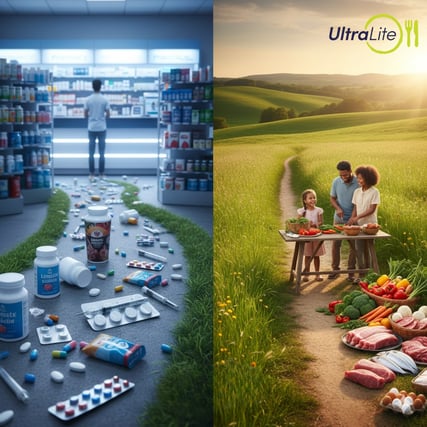
The Great Food Experiment: How Industrialised Foods Replaced Real Nutrition
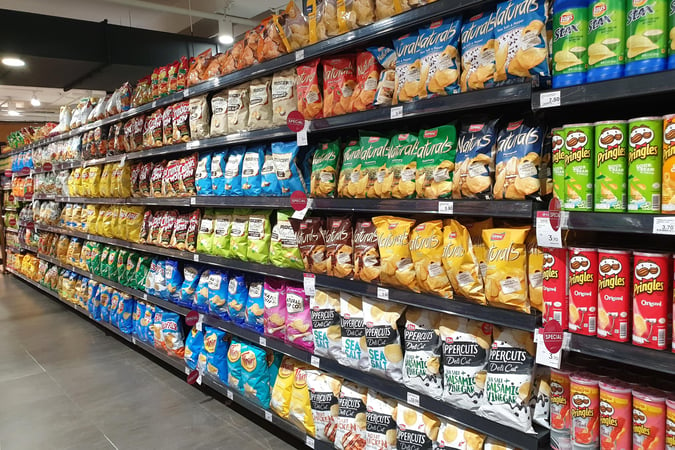
The Business Model Nobody Talks About
To understand the modern food crisis, we must first understand a simple reality:
Most multinational food companies are not farmers.
They do not grow the food.
They do not raise the livestock.
They do not produce the eggs, vegetables, fruit, milk, meat, nuts, or grains that form the foundation of human nutrition.
Instead, they purchase commodities at the farm gate and transform them into products that can be sold for many times their original value.
This process is called "value adding."
On the surface, value adding sounds positive.
But in many cases, the opposite occurs.
The further food moves away from its natural state, the more profitable it often becomes.
A farmer may receive only a small return for a tonne of corn, wheat, milk, potatoes, fruit, or sugar cane.
Yet once that same raw ingredient enters a manufacturing facility, it can be broken apart, refined, concentrated, chemically altered, flavoured, coloured, packaged, advertised, and sold back to consumers at many times its original value.
The challenge is that during this process, many of the natural characteristics of the original food are either reduced or completely removed.
Nature's food becomes industry's product.
From Food to Formulation
Farmers produce food. Manufacturers produce products. Somewhere between the farm gate and supermarket shelf, nutrition can become secondary to profitability.
Whole foods arrive at the factory containing a complex matrix of nutrients.
They contain fibre.
They contain naturally occurring vitamins and minerals.
They contain water.
They contain protein.
They contain healthy fats.
Most importantly, they contain natural mechanisms that help regulate appetite and satiety.
The manufacturing process often strips away these characteristics.
What remains are isolated ingredients.
Refined starches.
Concentrated sugars.
Industrial oils.
Protein isolates.
Flavour enhancers.
Colourings.
Emulsifiers.
Preservatives.
Texture modifiers.
The food industry doesn't simply process food.
It reformulates food.
The goal is not necessarily better nutrition.
The goal is often greater shelf life, lower production costs, greater convenience, stronger consumer appeal, and higher profit margins.
Why Whole Food Isn't Always Good Business
A simple crop can be transformed into dozens of ultra-processed ingredients including glucose syrup, maltodextrin, modified starches and sweetened snack foods.
The uncomfortable reality is that whole food has limitations from a commercial perspective.
Fresh food spoils.
Fresh food requires refrigeration.
Fresh food has transport challenges.
Fresh food generally cannot be patented.
Fresh food has limited opportunities for value multiplication.
An apple is largely still an apple.
A potato is largely still a potato.
A steak is still a steak.
But when those foods are transformed into breakfast cereals, flavoured snacks, sweetened beverages, meal replacements, desserts, confectionery, energy bars, and convenience foods, profit margins can increase dramatically.
The less food resembles its original form, the greater the commercial opportunity often becomes.
Engineering Cravings
Modern food manufacturing has become one of the most profitable industries in human history
Perhaps the most concerning development is that modern food science increasingly focuses on creating products consumers find difficult to stop eating.
This is not accidental.
Entire teams of scientists work to identify what is called the "bliss point"—the precise combination of sugar, salt, fat, texture, aroma, and flavour that maximises consumer enjoyment.
The result is a product designed not simply to satisfy hunger but to encourage repeat consumption.
Ingredients such as:
• Sugar
• Maltodextrin
• Glucose syrups
• Fructose concentrates
• Refined starches
• Flavour enhancers
• Artificial sweeteners
are frequently used because they are inexpensive, highly palatable, and commercially effective.
The objective is simple:
Sell more product.
The challenge is that biology has not evolved to handle continuous exposure to highly engineered foods.
The Farmer Versus The Factory
Nature packages food perfectly. Industry often repackages it for profit.
Farmers and food manufacturers often occupy opposite ends of the value chain.
The farmer's success depends upon producing quality food.
The multinational manufacturer's success depends upon creating products that maximise shareholder returns.
These goals are not always aligned.
A farmer can produce nutrient-dense eggs, vegetables, fruit, meat, milk, nuts, and grains.
But the greatest profits are often generated after those foods leave the farm.
By the time consumers purchase the final product, it may bear little resemblance to the food originally produced.
This is perhaps one of the greatest ironies of modern nutrition.
Human health depends upon real food.
Corporate profitability often depends upon transforming real food into something else.
Returning to Real Food
The solution may not lie in creating better processed foods, but in returning to food closer to its natural form.
The solution is not complicated.
It is not found in another processed snack.
It is not found in another fortified breakfast cereal.
It is not found in another highly marketed convenience product.
The solution begins by recognising food in its original form.
Food that grows.
Food that grazes.
Food that swims.
Food that flies.
Food that can be harvested, prepared, cooked, and shared.
The closer food remains to its natural state, the more likely it is to deliver the nutritional wisdom that nature spent thousands of years perfecting.
The future of health may not depend on inventing a better processed food.
It may depend on rediscovering the value of real food before it enters the factory gates.