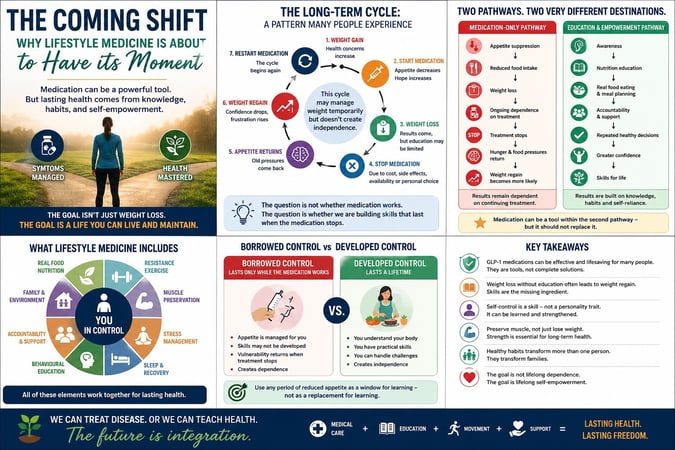
When appetite is controlled by medication, what happens to the person when the medication stops?
These are my thoughts, shaped by more than 25 years of experience helping people lose weight, change their relationship with food and regain confidence in their ability to manage their health.
We are living through an extraordinary period in weight management.
GLP-1-based medicines such as semaglutide and tirzepatide have changed what is medically possible. They can substantially reduce appetite, improve blood-glucose control and produce levels of weight loss that were previously difficult to achieve without surgery.
The benefits should not be dismissed. In the SELECT trial, semaglutide reduced major cardiovascular events by 20% among people with established cardiovascular disease who were overweight or living with obesity but did not have diabetes. That is a meaningful medical achievement.
But acknowledging what these drugs can do should not prevent us from asking an equally important question:
Do they create lasting health—or do they create results that remain dependent on continuing treatment?
My concern is not that GLP-1 medicines are ineffective.
They are clearly effective for many people.
My concern is that when medication becomes the entire weight-management strategy, it may suppress the problem without necessarily educating, strengthening or empowering the individual.
That is why I believe lifestyle medicine is approaching its defining moment.
The Difference Between Losing Weight and Learning Health
Weight loss is a physical outcome.
Health is a learned way of living.
A medication can reduce hunger, slow stomach emptying and influence the biological signals that regulate appetite and food intake. It may give someone welcome relief from relentless hunger or “food noise.”
However, medication does not automatically teach a person:
➡️how to identify nourishing food
➡️how to plan and prepare satisfying meals
➡️how to read ingredient labels
➡️how to distinguish physical hunger from emotional eating
➡️how to manage stress without food
➡️how to recover after an indulgence
➡️how to maintain adequate protein
➡️how to preserve strength and muscle
➡️how to build routines that survive weekends, holidays and family pressures.
These abilities are not contained in an injection.
They must be taught, practised and eventually owned by the individual.
That does not make medication wrong. It means medication and education perform different functions.
Medication may quiet the appetite.
Education teaches people what to do with that opportunity.
ILLUSTRATION: TWO PATHWAYS
Appetite suppression
↓
Reduced food intake
↓
Weight loss
↓
Ongoing dependence on treatment
↓
Treatment stops
↓
Hunger and food pressures may return
↓
Weight regain becomes more likely
Education-and-empowerment pathway
↓
Nutrition education
↓
Structured real-food eating
↓
Accountability and support
↓
Repeated healthy decisions
↓
Greater confidence
↓
Skills that can be used for life
The two pathways do not have to compete. Medication may be used as a tool within the second pathway—but it should not replace it.
What the Withdrawal Studies Tell Us
The real test of a weight-loss intervention is not simply what happens while a person is following it.
The real test is what remains when the intervention is reduced or removed.
In the STEP 1 extension study, participants who had received semaglutide regained approximately two-thirds of their previous weight loss during the year after treatment ended. Many of the cardiometabolic improvements also began moving back towards their starting levels.
The SURMOUNT-4 trial produced a similar warning.
Participants initially lost an average of 20.9% of their body weight during 36 weeks of tirzepatide treatment. Those who continued the medication lost a further 5.5% during the following year. Those switched to placebo regained an average of 14%—despite continuing to receive counselling about diet and physical activity.
These findings do not prove that the medicines failed.
They show that the medicines continued to perform an important biological function while they were being taken.
When that function was removed, the biological pressures favouring weight regain re-emerged.
This is precisely why GLP-1 medicines are increasingly described as long-term treatments rather than short courses.
But that creates a major question for individuals and health systems:
Is lifelong pharmaceutical appetite control the only maintenance plan we intend to offer?
The Long-Term Cycle
For some people, the experience may develop into the following cycle:
1. Weight gain creates concern
The individual becomes worried about appearance, mobility, blood pressure, blood glucose or future disease.
2. Medication provides rapid hope
Appetite decreases. Portions become smaller. The scales begin moving.
The person may feel that something has finally worked.
3. Weight falls—but education may remain limited
Because hunger is quieter, the person may eat less without necessarily understanding why previous eating patterns developed.
They may lose weight without learning a sustainable food structure, building strength or addressing emotional triggers.
4. Treatment becomes difficult to continue
This may occur because of cost, adverse effects, availability, treatment fatigue, changing circumstances or a personal desire to live without ongoing medication.
5. Appetite returns
The person is once again exposed to old habits, food environments, emotional pressures and biological hunger—but may not possess a strong behavioural maintenance system.
6. Weight begins to return
The individual may interpret this as personal failure.
But the medication had been performing much of the appetite-regulation work. When it was removed, the underlying pressures returned.
7. The person restarts treatment
Confidence in personal ability may decline while dependence on the external solution increases.
The cycle then begins again.
ILLUSTRATION: THE REVOLVING DOOR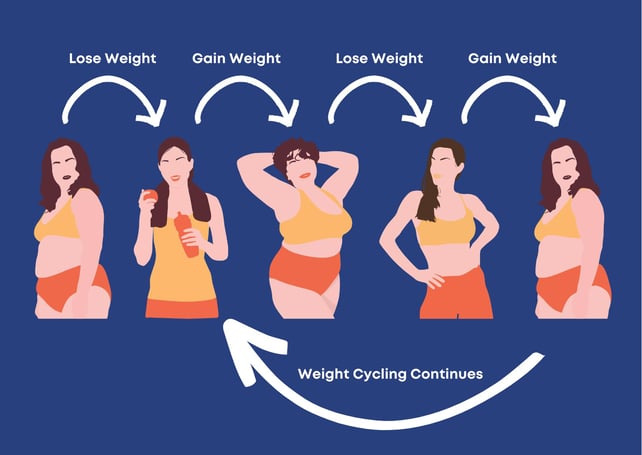
Start medication → Lose weight → Stop medication → Regain weight → Restart medication
This revolving door may be commercially sustainable for a pharmaceutical company.
It may be medically justified for some patients.
But it is not the same thing as teaching a person how to become the capable guardian of their own health.
Self-Control Is Not Shame
Whenever self-control is mentioned in a discussion about obesity, some people assume it means blame.
That is not what I mean.
Obesity is complex. Genetics, hormones, sleep, stress, medications, trauma, social circumstances, income, food availability and an environment saturated with highly processed food can all influence weight.
The World Health Organization describes obesity as a complex, chronic and relapsing disease requiring comprehensive, lifelong care.
Therefore, telling someone to “just use more willpower” is neither compassionate nor adequate.
But it is equally unhelpful to suggest that people have no agency at all.
Self-control is not a moral verdict.
It is a collection of trainable skills:
· recognising a trigger before responding to it
· planning food before becoming excessively hungry
· delaying an impulse
· creating an environment that supports good decisions
· choosing food that provides genuine nourishment
· learning from a setback instead of surrendering
· repeating beneficial actions until they become habits.
People are not born knowing how to do all these things.
They develop them through awareness, structure, education, encouragement and practice.
Real compassion does not shame people for struggling.
Neither does it convince them that they are powerless.
Real compassion helps people become more capable.
Borrowed Control Versus Developed Control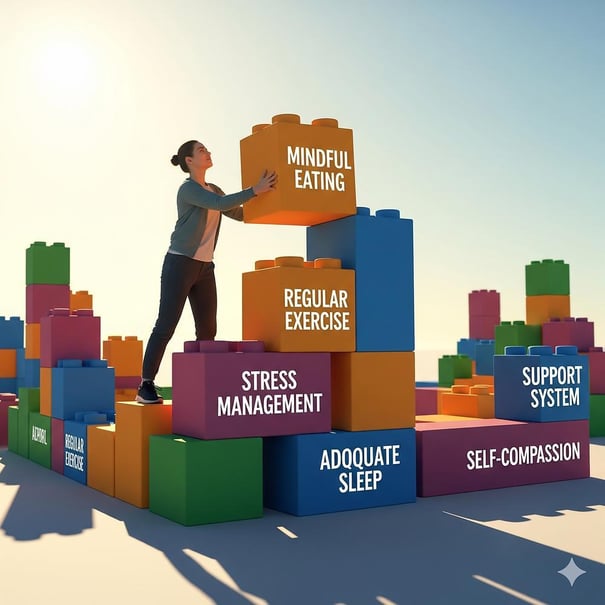
GLP-1 therapy can provide what I would describe as borrowed control.
The medication reduces appetite and makes eating less considerably easier for many people.
That relief can be extremely valuable.
However, borrowed control lasts only while the mechanism providing it remains effective.
Developed control is different.
It comes from understanding food, knowing one’s vulnerabilities, planning ahead, building routines and repeatedly making conscious decisions.
Borrowed control may begin the journey.
Developed control helps a person continue when conditions change.
The ideal program would use any period of reduced appetite as a window for learning—not as a replacement for learning.
A person using medication should be encouraged to ask:
· What am I learning while my appetite is quieter?
· Am I building meals I could continue eating?
· Am I improving my cooking skills?
· Am I preserving my muscle?
· Am I becoming physically stronger?
· Am I addressing emotional eating?
· Do I have a maintenance plan?
· What would I do if this medication became unavailable?
Without answers to these questions, weight loss may remain a temporary result rather than a lasting transformation.
The Muscle Question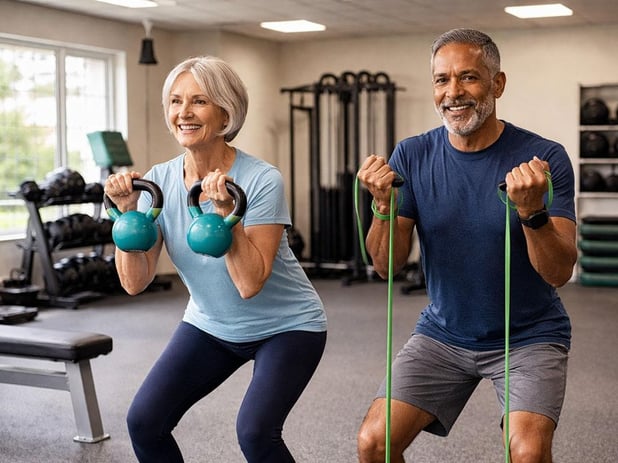
The number on the scales does not reveal what kind of weight has been lost.
During any substantial weight reduction, some lean tissue may be lost along with body fat. Research into GLP-1-based treatment shows considerable variation: some trials report a relatively small proportion of weight loss coming from lean mass, while others report much larger proportions.
Researchers also warn that “lean mass” is not identical to skeletal muscle because measurements can include water, organs, bone and other tissues. The full effect of these medicines on muscle strength, function and long-term physical independence therefore requires more careful study.
This issue matters particularly for older adults.
Successful weight management should not merely create a lighter person.
It should help create a person who is:
✅lighter
✅stronger
✅more mobile
✅metabolically healthier
✅better nourished
✅more physically independent.
That requires adequate nutrition and appropriate resistance exercise—not appetite suppression alone.
What Medication Cannot Do for a Family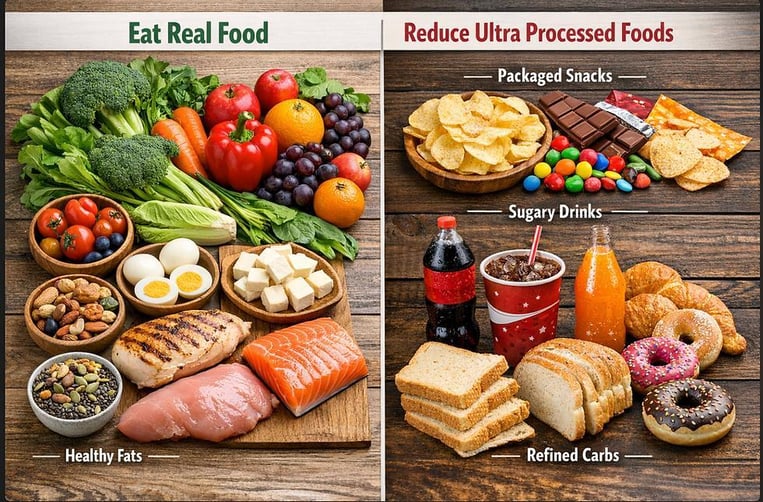
A prescription is given to one individual.
Education can transform an entire household.
When someone learns how to prepare satisfying meals from real food, the benefits can flow to a spouse, children and grandchildren.
A family can learn together:
👉how to reduce highly processed food
👉how to cook simple meals
👉how to make protein and vegetables central to eating
👉how to recognise marketing disguised as nutrition
👉how to manage treats without making them daily necessities
👉how to use food to support health rather than merely satisfy impulses.
Medication treats the patient.
Lifestyle education can influence a generation.
This is one of the greatest differences between disease management and health education.
What the World Health Organization Is Actually Saying
In December 2025, the World Health Organization conditionally recommended GLP-1-based therapies for the long-term treatment of obesity in adults.
However, the recommendation was conditional because of limitations and uncertainties involving:
➡️long-term efficacy and safety
➡️maintenance and discontinuation
➡️cost
➡️health-system preparedness
➡️access and equity.
The WHO also recommended structured behavioural interventions involving healthy eating and physical activity for people receiving these medicines—and stated plainly that medication alone will not solve the obesity crisis.
That is an important distinction.
The emerging medical position is not:
“Take an injection and forget lifestyle.”
It is closer to:
“Medication may be useful, but it must exist within comprehensive, lifelong and person-centred care.”
That should include education, movement, healthy food, behavioural support, accountability and an individualised maintenance strategy.
In other words, the future is not necessarily medication or lifestyle.
The future should be medication, when clinically appropriate, within lifestyle medicine.
Why Lifestyle Medicine Is About to Have Its Moment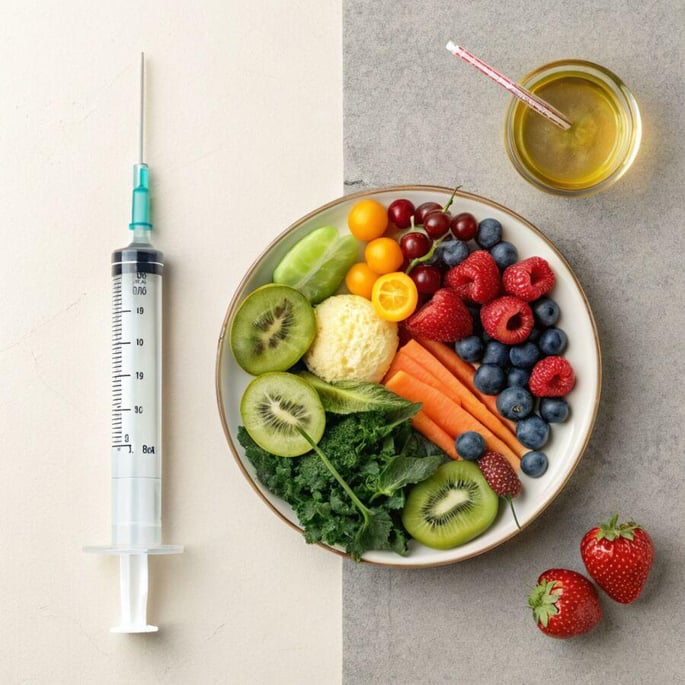
I believe the first phase of the GLP-1 era was dominated by excitement.
People saw dramatic transformations. Social media filled with before-and-after photographs. Demand surged. The treatment was frequently discussed as a revolutionary solution.
The next phase will be defined by more mature questions:
🤔Can people afford to remain on treatment?
🤔What happens after several years?
🤔What happens when treatment stops?
🤔How much strength and muscle have they preserved?
🤔Has their relationship with food changed?
🤔Are they eating nourishing meals or simply eating less?
🤔Have they become healthier or merely lighter?
🤔Do they feel empowered—or dependent?
🤔What maintenance skills have they acquired?
🤔Who is supporting them after the initial weight loss?
These questions will create a renewed demand for credible lifestyle-based programs.
Not fad diets.
Not punishment.
Not shame.
Not another temporary challenge.
People will seek structured pathways that combine:
✅real-food nutrition
✅practical education
✅human support
✅regular accountability
✅resistance exercise
✅muscle preservation
✅emotional awareness
✅relapse planning
✅family-friendly eating
✅long-term maintenance.
That is the coming opportunity for lifestyle medicine.
The Practitioner’s Changing Role
The practitioner of the future should not merely dispense a product or monitor a number on the scales.
The practitioner should become an educator, mentor and guide.
Their role should include helping people understand:
🤔what to eat
🤔why they are eating it
🤔how appetite operates
🤔how habits form
🤔how to identify triggers
🤔how to build strength
🤔how to respond to setbacks
🤔how to maintain results
🤔how to work with medical professionals when medication is used
🤔how to discuss any reduction or discontinuation safely with the prescribing clinician.
No responsible lifestyle program should tell someone to stop prescribed medication independently.
But every responsible weight-management program should help clients build the knowledge and capability required to participate intelligently in decisions about their own health.
The Goal Is Not Perfection
Lifestyle medicine should never promise that education will make biology disappear.
People can learn healthy habits and still experience hunger.
They can understand nutrition and still struggle during stress.
They can exercise regularly and still require medical treatment.
The goal is not to prove that everyone can manage obesity without medication.
The goal is to ensure that medication is not offered as a substitute for knowledge, nourishment, movement and personal development.
Some people may require long-term pharmaceutical treatment.
Others may use it temporarily.
Some may be unable or unwilling to use it.
Every one of them still deserves education.
Every one of them still deserves a maintenance plan.
Every one of them should be helped to become as capable and independent as their circumstances allow.
A Bridge Should Lead Somewhere
Perhaps the most useful way to understand GLP-1 treatment is as a bridge.
A bridge can carry someone away from immediate danger.
It can create breathing room.
It can reduce risk and open possibilities that previously seemed unreachable.
But a bridge is not a destination.
It should lead somewhere.
It should lead towards:
✅better food
✅stronger muscles
✅greater mobility
✅improved metabolic health
✅emotional understanding
✅confidence
✅practical knowledge
✅sustainable routines
✅self-respect.
Without that destination, the individual may simply remain standing on the bridge, afraid of what will happen if they ever step off.
My Belief About the Future
I do not believe GLP-1 medicines have “run their course.”
They will remain important medical treatments, and their uses may continue to expand.
But I do believe the idea of medication as a complete, stand-alone answer to obesity will eventually run its course.
The public will increasingly recognise the difference between suppressing appetite and transforming a life.
The next great advance may not be another stronger injection.
It may be the rediscovery of principles we should never have abandoned:
Education.
Real food.
Movement.
Muscle.
Accountability.
Human support.
Personal responsibility without shame.
Self-respect.
Self-empowerment.
The ultimate measure of success should not be how effectively we create lifelong customers.
It should be how effectively we help people become informed and active participants in their own health.
Medication can be a valuable tool.
But lasting health cannot simply be injected.
It must also be learned, practised, strengthened and lived.
That is why I believe lifestyle medicine is about to have its moment.
Educational notice: This article presents an informed personal perspective and is not individual medical advice. GLP-1 medicines should be commenced, adjusted or discontinued only in consultation with an appropriately qualified healthcare professional.
References (with Illustrative Figures)
1. World Health Organisation (WHO). (2025).
Report of the WHO Expert Consultation on the origins of SARS-CoV-2 and ongoing evidence review. Geneva: WHO.
Illustration:
Virus→ Lab → Data → Global Review
Banner Photo: Global scientific investigation and viral research overview
2. World Health Organisation (WHO). (2025).
Guideline on the management of obesity with GLP-1 receptor agonists and dual GIP/GLP-1 therapies. Geneva: WHO.
Illustration:
Overeat ➜Obesity ➜ GLP-1 ➜ Weight loss
Banner Photo: Modern obesity treatment and metabolic health management
3. U.S. National Intelligence Council. (2025–2026).
Updated assessment of COVID-19 origins: declassified summary reports. Washington, DC.
Illustration:
Classified→Declass→ Report → Analysis
Banner Photo: Declassified intelligence and analytical review process
4. Andersen et al. (2020).
The proximal origin of SARS-CoV-2. Nature Medicine.
Illustration:
Virus→ Genome → Study→ Publication
Banner Photo: Genomic research and scientific publication workflow
5. Pekosz et al. (2026).
Genomic analysis of SARS-CoV-2 and evaluation of laboratory engineering hypotheses.
Illustration:
Genome Scan → Lab Test → Evaluation → Results
Banner Photo: Advanced genomic sequencing and laboratory analysis
6. Rubino et al. (2026).
Discontinuation of GLP-1 receptor agonists: metabolic and cardiometabolic consequences.
Illustration:
Treatment➜ Stop ➜Weight ➜ regain Heart risk
Banner Photo: Metabolic health and treatment continuity considerations
7. Wilding et al. (2021).
Once-weekly semaglutide in adults with overweight or obesity. NEJM.
Illustration:
Weekly dose ➜ Time➜ Weight loss
Banner Photo: Weekly GLP-1 therapy and weight reduction outcomes
8. Rubino et al. (2022). SURMOUNT-4 Trial
Effect of continued tirzepatide vs withdrawal on weight loss maintenance.
Illustration:
Continue➜ Stop➜ Weight regain
Banner Photo: Weight maintenance and treatment continuation effects
9. Eli Lilly and Company. (2026).
Q1 2026 financial results and investor report.
Illustration:
Report ➜Growth➜ Revenue➜ Company
Banner Photo: Corporate growth and pharmaceutical market performance
10. Drucker (2018).
Mechanisms of action and therapeutic application of GLP-1. Cell Metabolism.
Illustration:
Brain →Appetite ↓ → Drug → Weight control
Banner Photo:Neuroendocrine control of appetite and metabolism
11. Holst (2007).
The physiology of glucagon-like peptide 1.
Illustration:
Food→ Hormone → GLP-1 → Metabolism
Banner Photo: Hormonal regulation of digestion and metabolism
12. Nauck & Meier (2019).
Incretin hormones: Their role in health and disease.
Illustration:
Food → Incretins→ Balance
Banner Photo:Incretin system and metabolic balance
13. Batterham & Cummings (2016).
Mechanisms of GLP-1–mediated appetite regulation.
Illustration:
Brain reduces appetite
Banner Photo: Appetite suppression and brain signaling
14. Diabetes Prevention Program (2002).
Lifestyle intervention or metformin reduces diabetes incidence.
Illustration:
Lifestyle change → lower diabetes risk
Banner Photo: Lifestyle intervention and diabetes prevention
15. Knowler et al. (2002).
NEJM Diabetes Prevention Study.
⚖️ Illustration:
Risk ➜ Intervention➜ Prevention
Banner Photo: Risk reduction through behavioural change
16. Look AHEAD (2013).
Cardiovascular effects of intensive lifestyle intervention.
Illustration:
Lifestyle➜ Heart health ➜ Outcomes
Banner Photo:Cardiovascular health and lifestyle medicine
17. Look AHEAD (2014–2016).
Long-term weight loss maintenance and behavioural predictors.
Illustration:
Weight loss ➜ Time➜ Maintenance
Banner Photo: Long-term weight management and sustainability
18. TGA (2026).
Safety updates on GLP-1 receptor agonists.
Illustration:
Drug ➜ Risk ➜ alert /Side effects
Banner Photo: Medication safety and regulatory monitoring
19. WHO (2025).
Global guideline for the management of obesity in adults.
Illustration:
Global ➜policy ➜Obesity care
Banner Photo:Global obesity policy and health strategy
20. NHMRC (2026).
National Strategic Framework for Chronic Conditions.
Illustration:
Policy➜ Strategy ➜ Health
Banner Photo: National health policy and chronic disease planning
21. Freeman et al. (2024).
Pharmacist-led weight management interventions.
Illustration:
Pharmacist care ➜ weight loss
Banner Photo: Community pharmacy and weight management support
22. American Diabetes Association (2024).
Standards of care in diabetes—lifestyle management.
Illustration:
Diet + Exercise + Guidelines
Banner Photo:Diabetes care standards and healthy lifestyle guidance
23. Lean et al. (2018). DiRECT Trial
Primary care-led weight management for diabetes remission.
Illustration:
Primary ➜ care➜ Weight loss Remission
Banner Photo: Diabetes remission through structured weight loss
24. Pi-Sunyer et al. (2015).
Liraglutide 3.0 mg weight management trial.
Illustration:
Drug➜ Weight loss ➜ Results
Banner Photo: Pharmacological weight management outcomes
25. Astrup et al. (2021).
Semaglutide safety and sustained weight loss.
Illustration:
Treatment➜ Time➜ Sustained loss
Banner Photo: Long-term efficacy of GLP-1 therapy