
Why patients must relearn real eating — and why structured whole-food keto is essential
Across medicine and pharmacy, a difficult realisation is now emerging: holding people on GLP-1 agonists without rebuilding real eating behaviour compromises long-term health. Appetite suppression can drive short-term weight loss, but it does not restore metabolism, protect muscle, or teach sustainable nutrition.
A new and serious problem is now appearing in practice: patients who are no longer hungry at all. When appetite is chronically suppressed and food intake becomes erratic or inadequate, metabolism stalls, lean mass is lost, and long-term consequences follow. Unless intervention occurs — and occurs correctly — we risk creating a generation of lighter but metabolically compromised patients.
This is not a failure of patients.
It is a failure of care design.
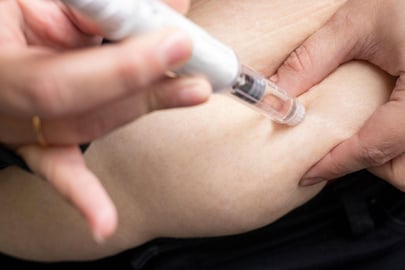
Appetite Suppression Is Not Metabolic Recovery
GLP-1 agonists reduce appetite. That effect can be clinically useful early on. But metabolism is not restored by not eating.
When patients:
- are rarely hungry,
- skip meals,
- rely on minimal intake,
- or are pushed toward liquid “solutions”,
the body adapts defensively. Resting metabolic rate drops, muscle tissue is sacrificed, micronutrient intake falls, and energy declines. Weight may reduce, but health quietly deteriorates.
Crucially, appetite suppression does not teach patients how to eat when appetite returns — and it always does.
Why “Meal Replacement” Is the Wrong Intervention
In response to concerns about long-term GLP-1 use, some have proposed meal-replacement shakes as an “off-ramp”. This is a profound mistake.
Two starvation strategies do not make a solution.
Meal replacements:
- bypass chewing and normal digestion,
- fail to restore hunger–satiety signalling,
- reinforce food avoidance,
- increase muscle-loss risk,
- and perpetuate dependency.
They replace one external controller (a drug) with another (a sachet). That is not rehabilitation — it is delay.
If the problem with GLP-1 therapy is loss of capability, then liquid restriction worsens the problem.
Chewing Whole Food Is a Clinical Requirement, Not a Preference
Human metabolism expects real food that must be chewed.
Chewing:
- slows eating,
- activates satiety pathways,
- improves meal satisfaction,
- stabilises blood glucose,
- and re-engages digestive and hormonal signalling.
Patients who are not eating whole food are not retraining metabolism. They are suppressing it.
This is why intervention must focus on structured whole-food eating, not avoidance.
Muscle Loss: The Silent Consequence
Rapid weight loss without adequate protein and resistance stimulus results in loss of lean muscle mass. This is now one of the most under-recognised risks of GLP-1–driven weight loss.
Loss of muscle leads to:
- reduced metabolic rate,
- fatigue and weakness,
- higher rebound risk,
- poorer ageing outcomes,
- and long-term health decline.
From a clinical standpoint, weight loss that compromises muscle is not a success.
Any ethical obesity intervention must prioritise:
- adequate protein,
- real meals,
- and muscle preservation.
Why a Structured Whole-Food Ketogenic Program Is Essential
Telling patients to “just eat whole food” is not enough — especially when appetite has been pharmacologically suppressed.
Structure matters.
A proven whole-food ketogenic program provides:
- clear meal structure even when hunger is low,
- adequate protein to protect muscle,
- metabolic stability through low glycaemic load,
- insulin regulation,
- and a pathway back to normal hunger signalling.
This is not starvation.
This is metabolic rehabilitation.
For more than 25 years, the UltraLite approach has demonstrated that when people eat real food, properly structured, metabolism recovers, muscle is preserved, and long-term weight control becomes achievable — without lifelong dependency on drugs or products.
Why This Matters to Medicine and Pharmacy
If patients remain on GLP-1 therapy without:
- real food reintroduction,
- structured eating,
- protein adequacy,
- and muscle preservation,
we will see:
- long-term metabolic damage,
- physical frailty,
- loss of self-efficacy,
- and escalating healthcare burden.
Pharmacists and clinicians have a responsibility to ensure patients are not merely losing weight — but regaining metabolic function.
That cannot happen through injections alone.
And it cannot happen through shakes.
The Correct Intervention Pathway.jpg?width=505&height=654&name=Building_your_plate_nutrion_label%20(1).jpg)
For patients on GLP-1 agonists, the pathway must include:
- Immediate whole-food reintroduction
Even when appetite is low. - Protein-anchored meals
To protect lean muscle. - Chewing and structured eating
To restore digestive and hormonal signalling. - A defined transition plan
Away from dependency toward independence. - A proven framework
Not guesswork, not starvation, not replacement products.
This is exactly where a structured ketogenic whole-food program excels.
The Bottom Line
GLP-1 agonists may reduce appetite.
They do not restore metabolism.
Meal-replacement shakes may reduce calories.
They do not rebuild health.
Only whole food — eaten, chewed, structured, and supported — can restore metabolic function and protect long-term health.
For patients currently on GLP-1 therapy, intervention is not optional.
It is essential.
And it must be done correctly.
If you are a clinician, pharmacist, or patient seeking a proven, structured whole-food pathway that restores health rather than suppresses it, explore the philosophy and clinical outcomes behind UltraLite at:
👉 www.weightlossforlife.com.au
Because the goal is not lifelong appetite suppression.
The goal is lifelong metabolic capability.
Meet Malcolm Today!
.jpg?width=428&height=571&name=Malcolm%20New%20Headshot_%20(1).jpg)
Founder and General Manager of UltraLite Progam
Join UltraLite Today!
For 26 years, UltraLite’s healthy ketogenic program has changed lives. Join the success stories—or step up and help others succeed as an UltraLite practitioner.
.jpg?width=424&height=282&name=Untitled%20design%20(1).jpg)